
Lifestyle guidance
Tips made for you, based on your numbers. What you do with them is up to you.

Every rhythm check you do also builds something else: a view of how your sleep, stress and habits shape your heart health. No extra effort. No extra device.
FibriCheck is a medical device that reads your pulse signal through your smartphone camera. It then analyzes this data to first check your rhythm. Only when your rhythm is regular can your health metrics be calculated; measurements with an irregular rhythm are flagged for follow-up instead. FibriCheck also collects the symptoms you felt and how severe they were, and lets you track vital signs such as blood pressure and weight, giving you and your doctor one aggregated view of your heart health that you can use to adapt your lifestyle choices.
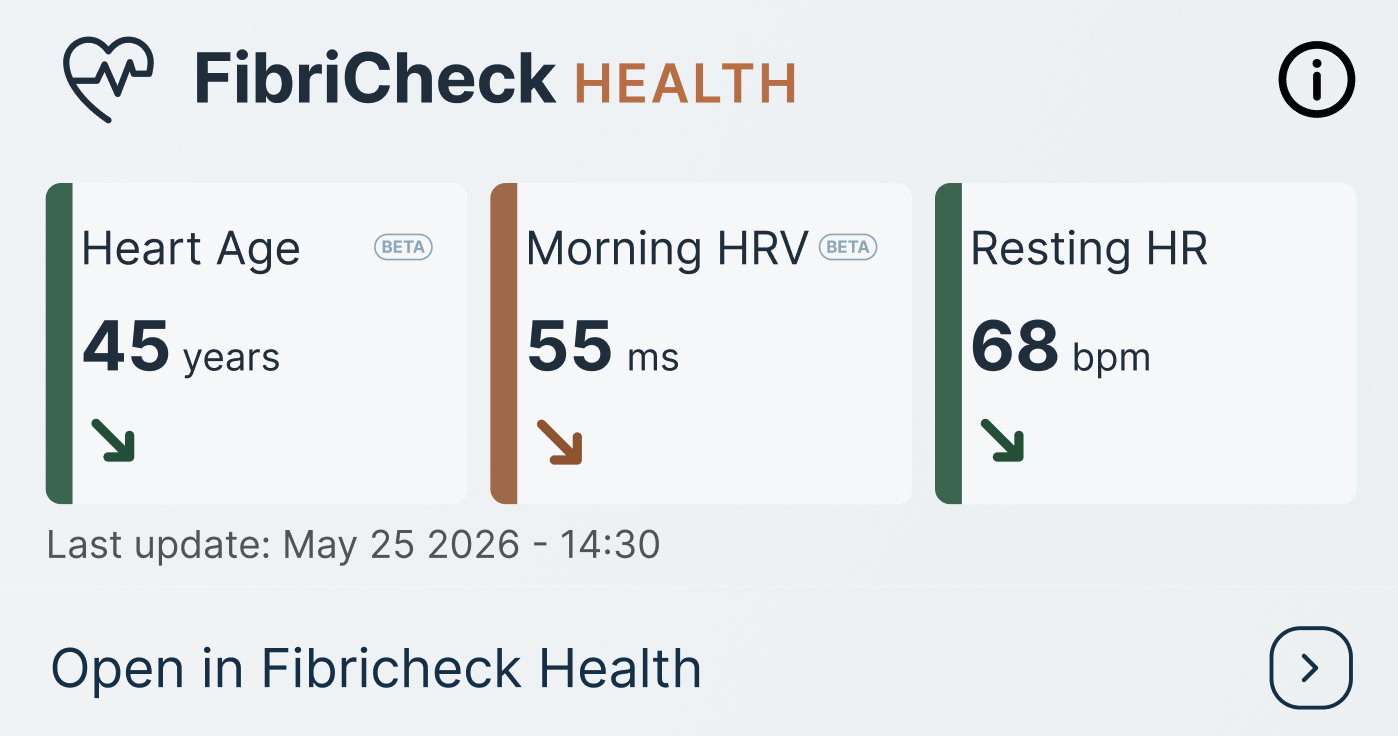
A single, easy-to-grasp number built from your FibriCheck pulse measurements. It tells you whether your cardiovascular system is behaving younger or older than your actual age. Unlike the daily recovery metrics, this one moves slowly, over weeks and months, reflecting how your lifestyle is shaping your heart health over time. Lower than your real age is a good sign; higher is a gentle prompt that your habits have room to improve.
It's your daily recovery check. A higher-than-usual number means you're well rested and ready to go; a lower one is your body telling you it's still recovering from stress, poor sleep, hard exercise, or that glass of wine last night.
How many times your heart beats per minute at rest. Over the long run, a lower resting rate reflects better fitness. Day to day, it's a recovery signal: a morning that's a few beats above your normal usually means your body is under strain from poor sleep, stress, alcohol, or oncoming illness.
How steady your morning HRV has been over the past week. It's the consistency of your recovery. A steady, low-swing week means your body is adapting smoothly and coping well. Bigger day-to-day swings suggest your system is being knocked around and recovery is uneven, so it's worth looking at sleep, stress, and training load.
Real change takes weeks, not days, and everything here is paced for that.
Tips made for you, based on your numbers. What you do with them is up to you.
When your numbers point to a theme worth working on, FibriCheck may offer you a step-by-step program.
When the numbers help the doctor's words land
My doctors told me for years. It was seeing my own heart age that finally got through to me.
During my pregnancy, doctors found I was likely to develop high blood pressure early. Ten years later, my numbers looked fine to me, but my doctors disagreed, and prescribed medication. I refused. I felt too young. My numbers didn't feel extreme.
Then I started tracking with FibriCheck, and saw my heart age was well above my real age. Colleagues my age didn't have that gap. My first instinct was to blame the app. Eventually I started the medication anyway, and watched my heart age come back down toward my real age. I'm not there yet. But it's what got me started.
The price of FibriCheck can be found in the app. You can download the app for free and activate a 3 day free trial, which you can cancel at any time.
FibriCheck does two things. One is a medical check of your heart rhythm. The other is a set of general health insights, and it is important to know the difference. The heart rhythm check is the core of FibriCheck, and it is a certified medical device function: you place your finger on your phone's camera for 60 seconds, and FibriCheck analyses your heart rhythm and looks for irregularities such as atrial fibrillation. You get a clear result, and every result comes with a clear next step. FibriCheck does not give a diagnosis. Only a doctor can do that. Health Insights, such as your heart age, heart rate variability and resting heart rate, are for information and lifestyle support only. They are not medical results, and they are not used to diagnose or treat any condition. FibriCheck does not replace an ECG ordered by your doctor, it cannot detect a heart attack, and it is not for emergencies. If you feel unwell, contact your doctor or the emergency services right away.
No. Your smartphone's camera is the only thing you need.
FibriCheck works on most iPhones and Android phones.
No. Your health insights help you live healthier, but they are not diagnoses and never replace your doctor. The rhythm check, the medical side of FibriCheck, is explained on the FibriCheck Medical page.
Measure today, and today becomes the day everything gets compared to. Free for 3 days, cancel anytime. iOS and Android. No wearable needed.
