
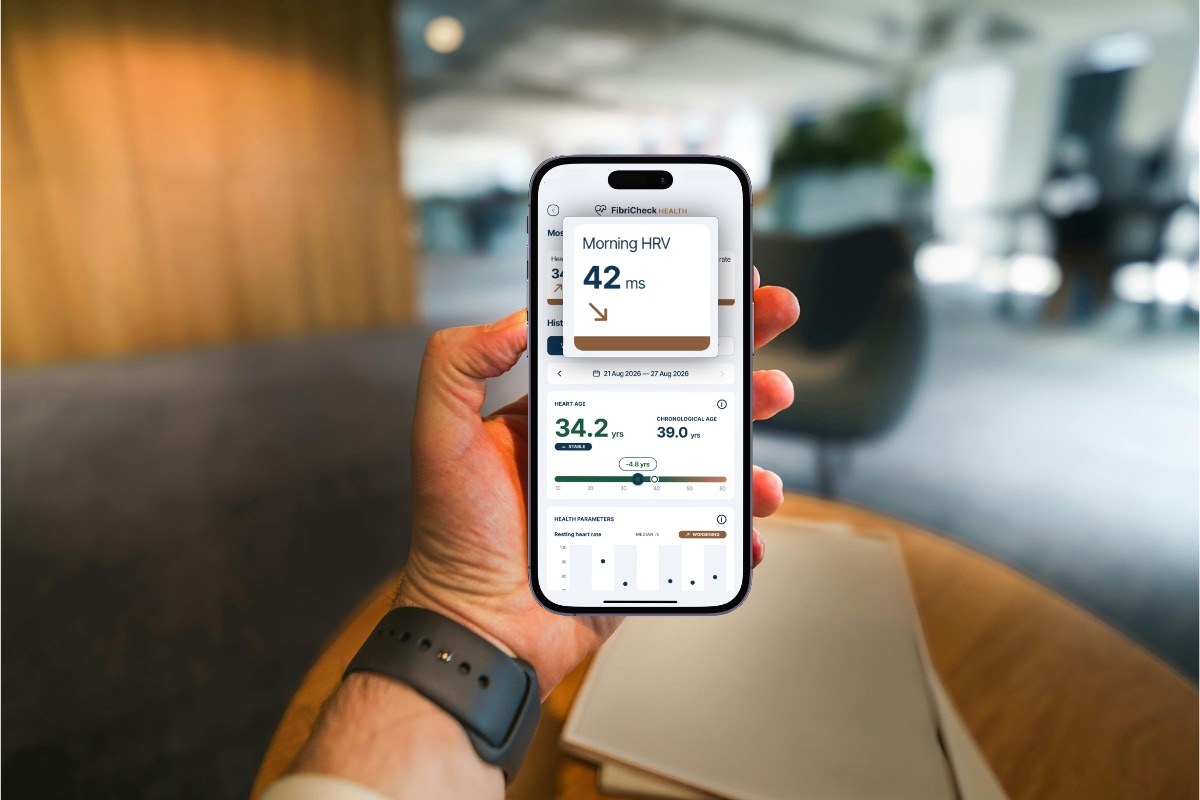
Sleep, alcohol, and stress: they all leave a trace on your health that you cannot always feel the next morning. FibriCheck built morning HRV to make that trace visible, as a single daily number you can check before your day even starts. This number works on two timescales: day to day, it tells you how well your body is dealing with daily changes. Over weeks, the trend tells you whether your habits are helping or working against your recovery.
What is HRV?
Your heart doesn’t beat at exactly the same speed every time, even when you’re calm and resting. The time between each beat can get a tiny bit longer or shorter, over and over. This is called Heart Rate Variability, or HRV for short. Having some variation here might sound like a bad thing, but it’s actually a good sign. It means your body can switch easily between being active and being relaxed.
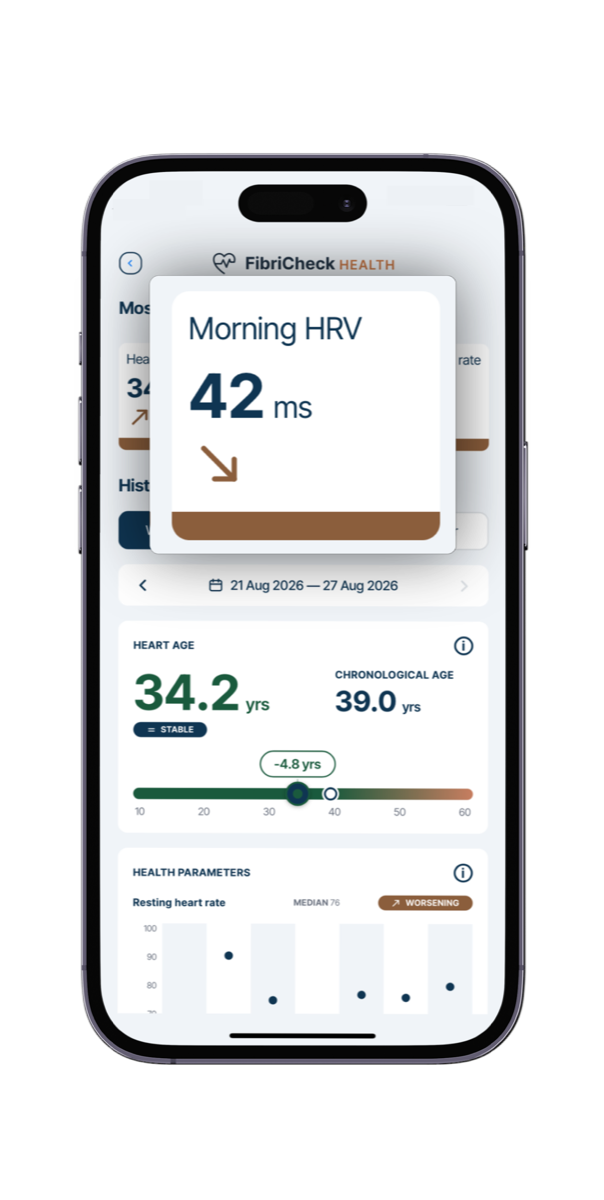
HRV is highly sensitive to everyday stressors: caffeine, a stressful meeting, a hard workout, poor sleep, alcohol,… That’s why FibriCheck recommends measuring each morning between 5 and 10 AM, ideally right after waking, before the day interferes. This way, your measurements are more standardized, which gives you meaningful insights.
What can you learn from your morning HRV?
Morning HRV will not diagnose anything. It is a mirror pointed at your own recovery and lifestyle, one morning at a time.
- Short term, it tells you something about your recovery: measured at roughly the same time each day, morning HRV becomes a real recovery check: a number around your usual baseline indicates that you are recovered and ready for your day, a lower number is your body telling you it is still working through yesterday’s stress, training load, or that last glass of wine. A number that is lower than usual is not a verdict, it is a nudge to go a bit easier on yourself: think about better sleep tonight, less alcohol this week, one less stressful commitment.
- Long term, it tells you more about your lifestyle: The trend in your HRV can be affected by your lifestyle choices and matters more than the number you receive on one single morning. A string of low mornings after a heavy week is worth noticing, one off morning is not.
Adding context to your measurements helps identify patterns in your HRV. This allows us to send you tailored educational content to help you understand your heart health metrics and support healthier lifestyle habits. With FibriCheck, we encourage you to discover what lifestyle choices impact your recovery and its consistency most.
What else can you check with FibriCheck Health?
Morning HRV is a fast mirror FibriCheck holds up to your recovery. Three other FibriCheck Health metrics enable you to get an even fuller picture of your heart health, all built from the same PPG signal:
- Resting heart rate: how many times your heart beats per minute at rest. Over the long run, a lower resting rate reflects better fitness. Day to day, it’s a recovery signal: a morning that’s a few beats above your normal usually means your body is under strain from poor sleep, stress, alcohol, or oncoming illness.
- HRV-fluctuation: how steady your morning HRV has been over the past week. This number indicates the consistency of your recovery. A steady, low-swing week means your body is adapting smoothly and coping well. Bigger day-to-day swings suggest your system is being knocked around and recovery is uneven, so it’s worth looking at sleep, stress, and training load.
- Heart age: a slower mirror. While morning HRV reacts to short-term changes, heart age reflects months of accumulated habits, changes in blood pressure, and other factors, distilled into one number that shows whether your heart is behaving younger or older than your real age.
Start your morning routine
Morning HRV becomes useful once you start measuring regularly.
Here is how to build your picture:
- Open FibriCheck between 5 and 10 AM, ideally right after waking up.
- Place your finger on the camera for 60 seconds, same as always. Keep the timing of your measurement consistent. That consistency is what turns today’s number into a trend you can trust, not just a one-off reading.
- Log the context. Sleep, alcohol, caffeine, exercise, or feeling under the weather, tagging it helps you connect the dots between a low morning and what caused it.
A measurement outside the 5 to 10 AM window still counts as a regular check-in, it just will not feed your morning HRV trend. The app will let you know.
Try it after a normal night and after a late one, and see the difference yourself.
Feeling stuck somewhere? Have a look at our FAQs or contact us via support@fibricheck.com.
FibriCheck’s heart age, morning HRV, HRV fluctuation, and resting heart rate insights are available as part of the free trial, Essential, and Premium subscriptions. They are heart health insights and are not part of FibriCheck’s medical features. FibriCheck’s health insights are not intended to diagnose, treat, or prevent any disease. Heart health insights are only calculated for regular (green) measurements.