
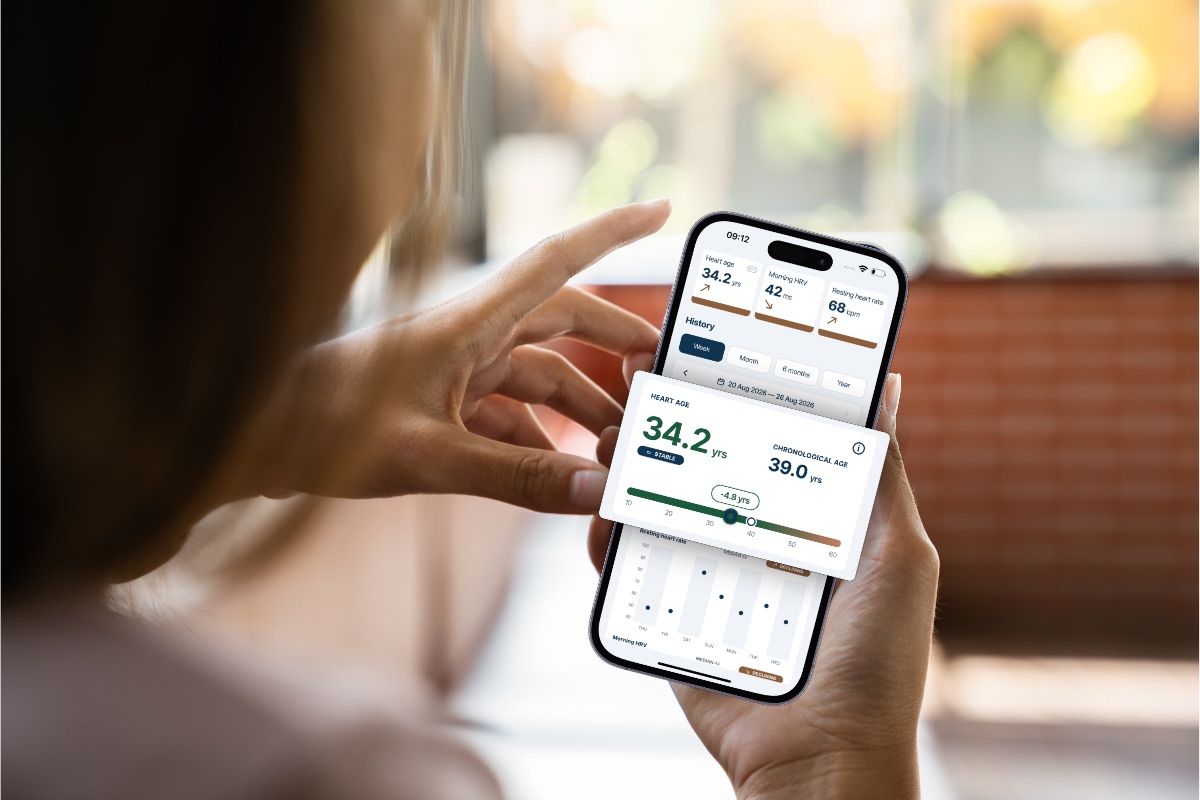
You know your age. Your heart may not agree.
Everyday habits like how you move, sleep, or unwind with a drink, leave a mark on how your heart ages. You can’t always feel this impact right away, so FibriCheck developed a feature to show you your real heart age as a single, intuitive number. You don’t need any additional hardware to see your heart age, just the FibriCheck app on the smartphone you already own.
What does your heart age say about your health?
Heart age is a single number that reflects whether your heart is behaving younger or older than your calendar age. It is based solely on patterns that FibriCheck has picked up across your own pulse measurements over time. Your genetics, family history, weight and blood pressure can all play a role in your heart age, next to the effect of hundreds of small lifestyle choices over the course of weeks. That is also why you can influence your heart age, but not fully control it. Keep in mind that your heart age is not meant as a diagnosis. Look at it as a mirror pointed at your own heart measurements over time.
Heart age changes slowly. Lifestyle shifts or factors like blood pressure feed into it over time. To make that easier to track, we label your heart age as stable, improving or worsening, so you can see the trend at a glance.
- Stable heart age: Your heart age hasn’t changed meaningfully over the tracked period. This is the expected state when your underlying risk factors (blood pressure, lifestyle habits, etc.) haven’t shifted.
- Improving heart age: Your heart age is trending down compared to your actual age, suggesting recent changes, such as better blood pressure control or healthier habits, are having a positive effect.
- Worsening heart age: Your heart age is trending upwards compared to your actual age, suggesting that recent changes, such as rising blood pressure or less favorable habits, are having a negative effect.
What can you learn from this number?
Your heart age shows you the real age of your heart, compared to your actual age. A number lower than your actual age is generally a good sign; higher is a gentle prompt that your heart health might deserve a little extra attention. We recommend checking your heart rhythm and blood pressure, and taking a critical look at your lifestyle.
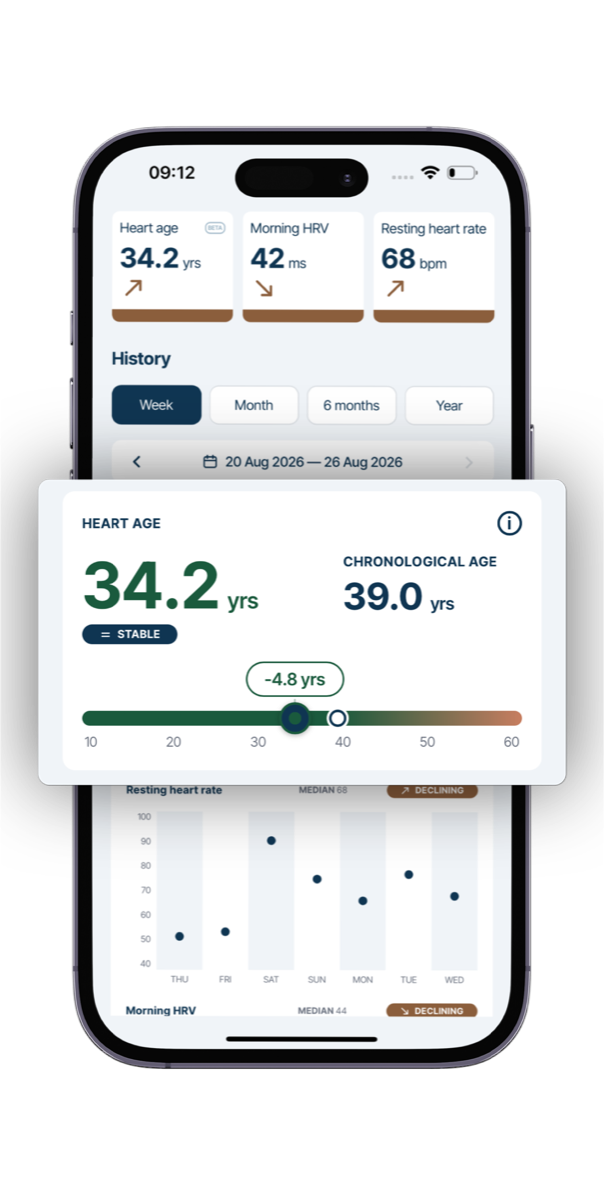
What you can do to move this number is have a look at your activity level, sleep quality, alcohol, stress, weight, and blood pressure. By changing enough of these small, modifiable factors consistently, you can have an effect on your heart age as well. It’s important to note that changes to your heart age happen over the course of weeks to months instead of overnight, and that you can’t have full control over your heart age as there are some factors like genetics and family history that you can’t change.
The context you provide with each measurement helps us learn what affects your heart health. This allows us to send you personalized educational content which helps you understand your heart better and motivates you to make healthy lifestyle choices that improve your heart health in the long run.
"My doctors told me for years. It was seeing my own heart age that finally got through to me."
During my pregnancy, doctors found I was likely to develop high blood pressure early. Ten years later, my numbers (110 over 85) looked fine to me — but my doctors disagreed, and prescribed medication. I refused. I felt too young. My numbers didn't feel extreme.
Then I started tracking with FibriCheck, and saw my heart age was well above my real age. Colleagues my age didn't have that gap. My first instinct was to blame the app. Eventually I started the medication anyway — and watched my heart age come back down toward my real age. I'm not there yet. But it's what got me started.
What else can you check with FibriCheck Health?
Heart age is the slow mirror of your heart. FibriCheck also gives you three faster ones, all built from the same underlying PPG signal:
- Heart Rate Variability (HRV): this reflects how your body is coping with stressors. A higher-than-usual number means you’re well rested and ready to go; a lower one is your body telling you it’s still recovering from stress, poor sleep, hard exercise, or that glass of wine last night. Also useful if you work out and want to know whether today is a push day or a rest day.
- Resting heart rate: how many times your heart beats per minute at rest. Over the long run, a lower resting rate reflects better fitness. Day to day, it’s a recovery signal: a morning that’s a few beats above your normal usually means your body is under strain from poor sleep, stress, alcohol, or oncoming illness.
- HRV-fluctuation: how steady your morning HRV has been over the past week. This number indicates the consistency of your recovery. A steady, low-swing week means your body is adapting smoothly and coping well. Bigger day-to-day swings suggest your system is being knocked around and recovery is uneven, so it’s worth looking at sleep, stress, and training load.
Start building your number
Heart age only means something once there are enough measurements behind it. The sooner you start measuring consistently, the sooner that number becomes yours to read, and yours to move.
Here is how to unlock it:
- Open FibriCheck and take a measurement. Place your finger on the camera for 60 seconds, same as always.
- Keep it up: regularly taking measurements helps you get the best picture of your heart health.
- Once you’ve performed at least 5 measurements within a 30 day window, your heart age appears in the app. Until then, the empty state shows you how many measurements are left. The more measurements you take, the more precise the number gets.
No new hardware, no extra steps, just the measurement you already take.
Feeling stuck somewhere? We’re happy to help. Have a look at our FAQs or contact us via support@fibricheck.com
FibriCheck’s heart age, morning HRV, HRV fluctuation, and resting heart rate insights are available as part of the free trial, Essential, and Premium subscriptions. They are heart health insights and are not part of FibriCheck’s medical features. FibriCheck’s health insights are not intended to diagnose, treat, or prevent any disease. Heart health insights are only calculated for regular (green) measurements.