
New FibriCheck features for higher engagement across your entire member base
Health insurers have long faced a familiar trade-off. Wellness apps are easy to start but hard to sustain. Engagement fades once novelty wears off, and the data they produce carries no clinical weight. Medical-grade tools deliver real credibility and proven results, but by design they reach only the members who already have a reason to measure: those with symptoms, a diagnosis, or a clinician’s instruction. Accessing the members that carry undetected risk that neither they nor their insurer can currently see, and that rarely shows up until a claim does, is the gap FibriCheck is now closing.
What’s new?
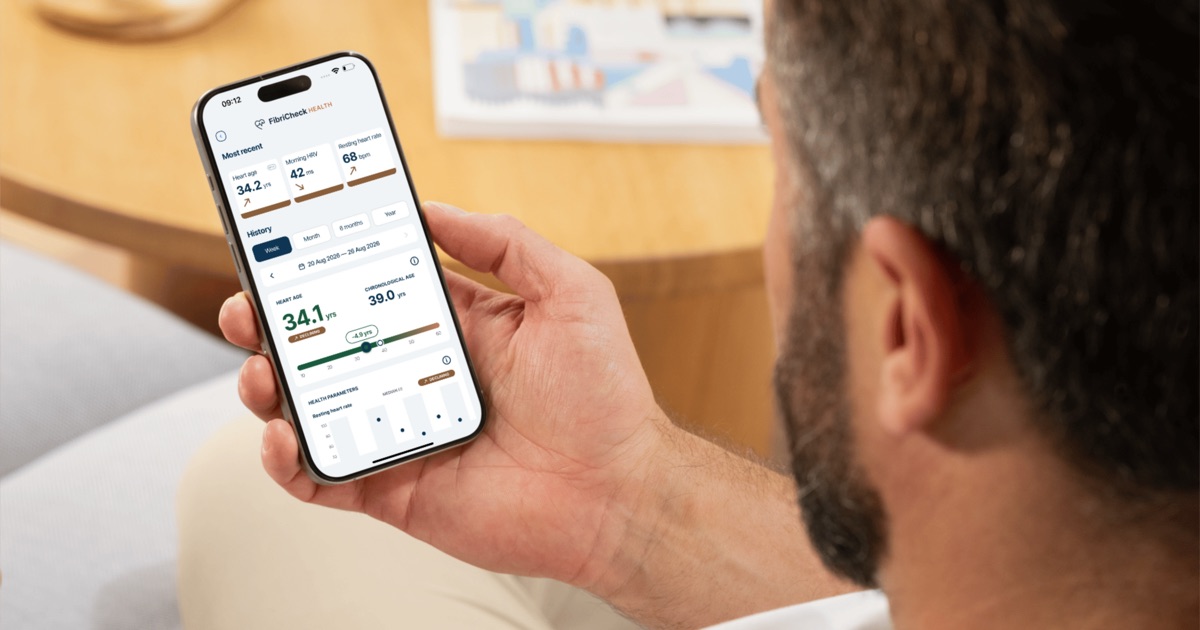
A single 60-second FibriCheck measurement now surfaces two things at once: clinically validated arrhythmia detection, together with a new layer of heart health insights, all derived from the same 60-second heart rhythm check, without any additional hardware or additional apps. The new heart health parameters are:
- Heart age: a single, easy-to-grasp number that tells you whether your cardiovascular system is behaving younger or older than your actual age. Consistently the most engaging metric in early rollouts. This metric moves slowly, over the course of weeks and months, and reflects how your lifestyle is shaping your heart health over time. Lower than your real age is a good sign; higher is a gentle prompt that your habits have room to improve.
- Morning heart rate variability (HRV): this reflects your day-to-day readiness and recovery. A higher-than-usual number means you’re well rested and ready to go; a lower one is your body telling you it’s still recovering from stress, poor sleep, hard exercise, or that glass of wine last night.
- Resting heart rate: how many times your heart beats per minute at rest. Over the long run, a lower resting rate reflects better fitness. Day to day, it’s a recovery signal: a morning that’s a few beats above your normal usually means your body is under strain from poor sleep, stress, alcohol, or oncoming illness.
- HRV fluctuation: this metric shows how steady morning HRV has been over the past week compared to the baseline HRV. It is an indicator of how well an individual recovers. A steady, low-swing week means the body is adapting smoothly and coping well. Bigger day-to-day swings suggest your system is being knocked around and recovery is uneven, so it’s worth looking at sleep, stress, and training load.
Users are asked to add daily context concerning sleep quality, alcohol intake, illness or exercise, so the results reflect the real link between lifestyle and heart health. Personalised educational content helps members act on what they see. Where measurements point towards a specific theme such as blood pressure, guided programmes support members in making meaningful changes.
Increase engagement throughout your entire member base
Until now, FibriCheck’s active users are mostly taking measurements after being diagnosed, when experiencing symptoms, or when a clinician instructs them to measure. That’s a valuable group of people, but a narrow one. The new FibriCheck Health parameters extend that reach to the members who have never had a reason to open a cardiac health app.
In practice, that means:
- Earlier and more frequent engagement, not limited to renewal periods or claims
- Sustained touchpoints with healthy members, consistently the hardest segment to reach in any health programme and also the group where undetected risk hides.
- One solution covers the full member journey, from healthy, to at-risk, symptomatic, and diagnosed, without introducing a second vendor or a second data stream to manage.
For teams who have faced the recurring ask internally for “more than AF screening,” this is a direct answer.
From claim-based to proactive: what this means for your programme
Wellness engagement changes how insurers communicate with members. Instead of a relationship defined by claims and renewals, the conversation becomes proactive: helping members understand and act on their own heart health before anything goes wrong.
FibriCheck is the only medically approved cardiac rhythm monitoring platform that combines clinically validated arrhythmia detection with a layer of heart health insights designed for daily engagement. Where pure wellness apps lack clinical credibility and pure medical apps reach only those already in the health system, FibriCheck now sustains engagement across the full member base, without compromising the clinical foundation that makes it trustworthy.
More data for population health planning
Broader, more consistent engagement also means more longitudinal data, drawn from a single tool rather than a stack of disconnected ones. Aggregated across a member base, this data can support programme design and population-level health planning: understanding engagement patterns, general health trends, and emerging risk across cohorts, earlier than claims data allows.
The takeaway
One 60-second measurement surfaces clinically validated arrhythmia detection and a layer of enhanced health insights. Where pure wellness apps lack clinical credibility and pure medical apps drop off after the screening, FibriCheck sustains engagement over time.
Interested in how this fits into your existing health programme? Let’s talk. Reach out to your FibriCheck contact or email business@fibricheck.com.