
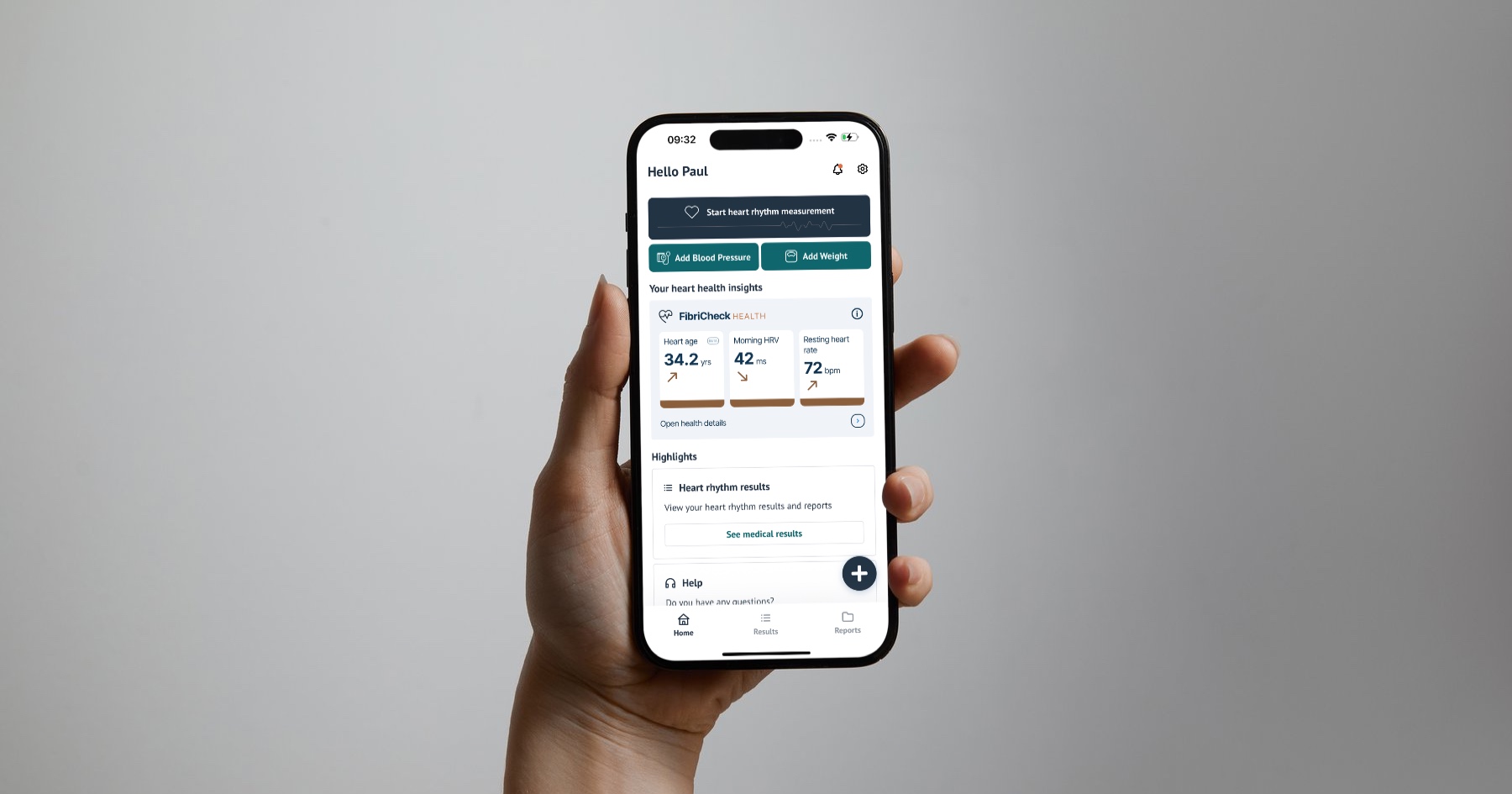
Your heart beats around 100,000 times a day. Most of the time you don’t even notice this, which is exactly why it is important to check in every now and then. With FibriCheck, all you need to do this is your smartphone and 60 seconds of your time.
In this blog, we explain three things:
- How FibriCheck reads your heart rhythm with your phone’s camera, and how that differs from an ECG at the doctor’s office.
- How one measurement turns into health insights about your heart.
- What each insight means for you, in plain language and why measuring regularly gives you a much clearer picture than measuring once.
What is PPG?
FibriCheck measures your heart rhythm with a technology called PPG, short for photoplethysmography. It sounds complicated, but the idea is simple.
Every time your heart pumps, your blood vessels widen for a moment and then relax again. When you place your fingertip on your phone’s camera, the flashlight shines onto your skin. This allows the camera to pick up those tiny changes in the blood flow of your fingertip, beat by beat. Your heart rhythm and its regularity can then be derived from this measurement, with 98.5% accuracy for AFib detection.
How is this different from an ECG?
You may know the ECG (electrocardiogram) from a visit to your doctor or the hospital. An ECG measures the electrical signals your heart produces every time it beats. In order to do this, sensors are attached to your skin, and a healthcare professional usually takes the measurement.
PPG with FibriCheck
- What it measures: changes in blood flow with each heartbeat
- What you need: your smartphone
- Where and when: anywhere, any time
ECG
- What it measures: electrical signals of your heart
- What you need: sensors on your skin, usually at a care provider
- Where and when: during an appointment, or with a portable device worn for a limited time
Why this matters for you
Many heart rhythm disorders come and go. Your heart can beat perfectly normally during a check-up and irregularly a few days later. Because FibriCheck works with the phone you already carry, you can measure when it suits you, and especially when you feel something is off. That makes it much easier to catch what an occasional check-up might miss.
From one measurement to clear insights
One 60-second measurement gives you six insights into your heart health. Here is what happens in that minute:
- You measure. Place your fingertip on the camera of your smartphone and stay still for 60 seconds.
- Your phone records your pulse. The camera captures your heart rate and heart rhythm.
- The algorithm analyses the signal. FibriCheck’s certified medical algorithm looks at how fast your heart beats and how regular the time between beats is.
- You get your results. You immediately see whether your heart rhythm is regular or not, plus health insights that show how your heart is doing over time.
Two types of results
Not every result has the same purpose, so it helps to know the difference:
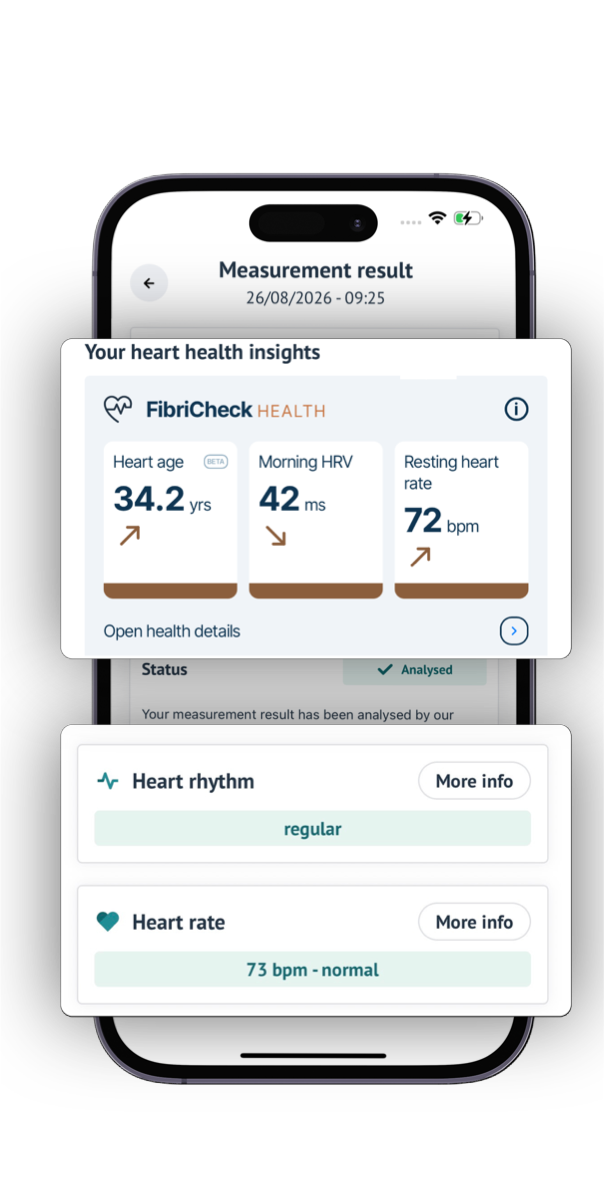
- Medical features: heart rhythm and heart rate. These are clinically validated results. They tell you whether your heart rhythm is regular, or whether there are signs of a rhythm disorder such as atrial fibrillation.
- Health insights: heart age, HRV, resting heart rate and HRV-fluctuation. These come from the same signal and help you understand your own patterns, like how well you recover or how fit your heart is. They are wellness features, not medical results.
You can also log your blood pressure, weight and symptoms in the app. Together, this gives you one complete overview of your heart health.
What each result means
Heart rhythm
Your heart rhythm shows whether your heart beats in a regular pattern. FibriCheck checks for signs of heart rhythm disorders such as atrial fibrillation. Atrial fibrillation often causes no clear symptoms, so many people don’t know they have it. Spotting it early gives you and your doctor time to act, which is important, as atrial fibrillation makes a stroke 5 times more likely.
Heart rate
Your heart rate is your pulse at the moment you measure, in beats per minute. It goes up when you move, feel stressed or drink coffee, and down when you rest.
Resting heart rate
Your resting heart rate reflects how many times your heart beats per minute when you are fully at rest. Over time, a lower resting heart rate usually reflects better cardiovascular fitness. If it is higher than usual on a certain morning, your body may be under strain from poor sleep, stress, alcohol or an illness coming on.
Heart Rate Variability (HRV)
Your heart does not tick like a clock. The time between two beats changes slightly all the time, and that is healthy. HRV measures that variation and shows you two insights:
- Short term: it tells you something about your recovery. A higher number than usual indicates that you are well recovered, while a lower number means you are still working through yesterday’s stress, training load, or that last glass of wine.
- Long term: it tells you more about your lifestyle.
HRV-fluctuation
HRV-fluctuation shows how steady your morning HRV has been over the past week. A steady week means your body is adapting smoothly. Bigger swings suggest your recovery is uneven, a sign to look at your sleep, stress or training load.
Heart age
Heart age tells you whether your heart and blood vessels behave younger or older than your actual age. This number moves slowly, over weeks and months. That makes it a good way to see whether healthier habits are paying off.
Why one measurement is not enough
One measurement is a snapshot. Regular measurements tell your story. Here is why it pays off to keep going:
- Rhythm disorders come and go. An irregular rhythm can come and go, often without any symptoms. The more often you measure, the bigger the chance you catch it.
- Your insights are personal. HRV, heart age, resting heart rate and HRV-fluctuation give you personalized insights. The more you measure, the more meaningful these results become.
- Trends say more than single numbers. A slightly higher resting heart rate on one day means little. The same rise for a full week is worth paying attention to.
- You see your progress. Sleeping better, moving more, cutting back on alcohol: your heart age and resting heart rate show whether it is working.
- You have something concrete to share. A history of measurements gives you and your doctor a much clearer picture than “I sometimes feel my heart racing”.
Make it a habit
- Measure every morning, shortly after waking up, before coffee or exercise. That keeps your results comparable from day to day.
- Measure whenever you feel something, like palpitations, dizziness or shortness of breath, and log your symptoms in the app.
- Check your trends weekly to see how your heart is doing over time.
Your heart works for you every second of the day. Give it 60 seconds back. Take your first measurement today, and make it a daily habit.
FibriCheck does not replace your doctor. Do you have complaints or are you worried about your heart? Contact your doctor. In case of an emergency, call your local emergency number.
References
- Around 100,000 heartbeats a day: https://pmc.ncbi.nlm.nih.gov/articles/PMC4179748/
- 98.5% AF detection accuracy vs ECG: Wouters F, Gruwez H, et al. (2025). Comparative Evaluation of Consumer Wearable Devices for Atrial Fibrillation Detection: Validation Study. JMIR Formative Research, 9, e65139.
- Atrial fibrillation and stroke risk: https://academic.oup.com/eurheartj/article/42/5/373/5899003?login=false